Stinzen Planting
- Chris Musser
- Sep 14, 2025
- 4 min read

Updated: Jan 16
Turning Hell Strips and Lawns Into a Sea of Blooms
Stinzen planting is a Dutch tradition that’s perfect for Portland: you scatter hardy spring-blooming bulbs so they come back every year, spread naturally, and look cheerful instead of fussy. No rows. No perfection. Just color when winter is dragging on, and pollinators are waking up hungry.
The magic happens when you combine bulbs with tough native plants. The bulbs do the early-spring show, then quietly disappear while natives take over for the rest of the year. The result is something that looks good, feeds pollinators, and doesn’t ask much of you.
This approach works especially well in parking strips (hell strips), but it also works in lawns, curb edges, and small front-yard patches.
Why bulbs + natives work so well
Early food for pollinators: Some bees and hoverflies wake up before most native plants bloom. Early bulbs fill that gap.
Less maintenance: Bulbs handle early spring; natives handle summer and fall.
Neighborhood-friendly: Bright spring flowers, followed by tidy green structure.
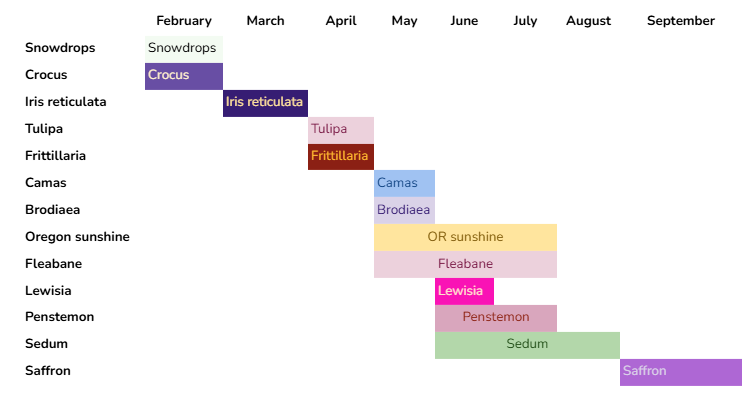
Forgiving: Miss a watering? Forget to weed once? Still fine.Some pollinators, such as hover flies, bumblebee queens, and honeybees become active before natives are blooming. Non-native bulbs can fill the gap. Snowdrops are the earliest bloomers and provide small amounts of nectar to bumblebee queens awaking from hibernation. Crocuses are excellent nectar and pollen sources for bees and hoverflies. Iris reticulata produces nectar accessible to bees. Tulipa (non-hybridized, “species” tulips) provide pollen, while fritillaria produces nectar accessible to long-tongued bumblebees.
Camas provides the highest value nectar and pollen for our local bees and hoverflies. Sweat bees and bumblebees prefer Brodeia. Last, saffron’s late blooms provide nectar and pollen when other forage is scarce, and are visited by honeybees, bumblebees, and hoverflies. Bulbs offer early nectar for pollinators and eye-catching beauty for neighbors just when winter feels longest. Native grasses, sedges, succulents, and herbaceous wildflowers carry the display and provide high-quality food through late spring and summer. Together, they create plantings that are both ecologically rich and community-friendly.
The basic idea (no gardening background required)
Plant native plants first (these are your long-term backbone).
Scatter bulbs among them in small groups.
Water the first year, then mostly let nature take over.
Don’t mow or cut back bulb leaves for about 6 weeks after flowering.
That’s it.
What to plant where
These examples are sized for a typical Portland parking strip (about 25 feet long × 3 feet wide). You can scale up or down easily.
🌞 Sunny, well-drained strip
Goal: lots of color, very little summer water
Base native plants (the backbone) | Why they work |
Idaho fescue (Festuca idahoensis) | Clumping grass, tidy, drought-tolerant |
Riverbank lupine (Lupinus polyphyllus) | Spring flowers, feeds bees |
Fleabane (Erigeron speciosus or E. glaucus) | Long bloom season |
Broadleaf stonecrop (Sedum spathulifolium) | Fills edges, handles heat |
Bulbs to mix in (by bloom time):
Snowdrops (Galanthus) – very early
Early iris (Iris reticulata)
Species tulips (wild tulips)
Fritillaria (fritillary)
Common camas (Camassia quamash)
Saffron crocus (Crocus sativus) for fall flowers
🌳 Dappled shade under street trees
Goal: early nectar without fighting tree roots
Base native plants | Why they work |
Fringecup (Tellima grandiflora) | Handles shade, spreads gently |
Coral bells (Heuchera species) | Evergreen-ish, tidy |
Native sedge (Carex pansa or Carex densa) | Tough, grass-like cover |
Inside-out flower (Vancouveria hexandra) | Loves dry shade |
Bulbs to mix in:
Snowdrops
Early iris
Fritillary (snake’s head fritillary)
Camas (planted toward the back)
These bulbs bloom before trees fully leaf out, so they still get spring sun.
🐝 Bee superhighway (maximum early nectar)
Goal: help pollinators from late winter through spring
Base native plants | Why they work |
Sea thrift (Armeria maritima) | Early flowers, sunny edges |
Riverbank lupine | Big spring nectar |
Native phacelia (Phacelia heterophylla) | Pollinator magnet |
Bulbs to mix in:
Snowdrops
Early iris
Species tulips
Fritillary
Camas
Saffron crocus (bonus fall flowers + actual saffron!)
✂️ Low-mow, looks good all year
Goal: neat structure with seasonal pops of color
Base native plants | Why they work |
Native low sedge (Carex pansa) | Acts like a lawn |
Oregon sunshine (Eriophyllum lanatum) | Gold flowers in spring/summer |
Penstemon (Penstemon davidsonii or P. serrulatus) | Flowers + structure |
Bulbs to mix in:
Snowdrops
Early iris
Species tulips
Camas
Mini daffodils
Saffron crocus
Simple planting & care tips
Depth matters: Plant bulbs at the depth listed on the package.
Let leaves die back: After flowering, wait about 6 weeks before mowing or cutting.
Avoid weed-and-feed products: They interfere with bulbs.
Mulch lightly: Especially under trees.
First year water: After that, most of these survive on rainfall alone.
A neighborhood tradition in the making
One of the best things about stinzen planting is how contagious it is. One parking strip turns into three. Then a whole block lights up in early spring when winter feels endless, and we all need a little color. It’s easy. It’s forgiving. And it makes both pollinators and neighbors happy.
If you’d like help choosing bulbs or native plants, or want to try this in your own strip, you can find more resources and seasonal offerings at East Portland Plant Buying Club.
Let’s make our sidewalks bloom.
What to Plant Where
Right plant, right place is my mantra. These planting recommendations are scaled for a typical parking strip about 25 feet long by 3 feet wide (~75 sq ft).


Comments